|
|
|
|
|
Wednesday
Former Guantanamo detainee appeals to overturn conviction
Known by the media as the 'Australian Taliban', David Hicks was captured by the U.S. in 2001 and became one of the first prisoners to set foot in Guantanamo's detention facility. After five and half years of detainment, and under extreme duress, Hicks took a plea deal over the charge of "providing material support for terrorism." However, six years after his release, Hicks maintains his innocence. And he has just launched an appeal against the United States to overturn, what he calls, a wrongful conviction. RT's Ameera David reports.
Journalist: Drug cartels destroying Mexico
Becky Anderson talks with Mexican investigative journalist Anabel Hernández about the country's war on drugs.
Ryan Ferguson: "I'm still standing in prison"
Ryan Ferguson, who has been jailed for more than a decade for a murder he says he didn't commit, speaks with 48 Hours' Erin Moriarty after his conviction was vacated Tuesday.


A "Sea of Death" for migrants
analyzes the hypocrisy of European border policies that fuel the far right's anti-immigrant scapegoating--while capital faces fewer restrictions than ever.
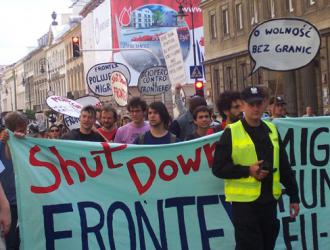
Immigrant rights activists march against Frontex
ON OCTOBER 3, a trawler with 500 migrants escaping poverty and war in North Africa caught fire and capsized near the Italian island of Lampedusa in the Mediterranean Sea. Only 155 people were rescued. Days later, 36 Syrian refugees drowned off the Malta cost when their boat overturned.
For migrants fleeing North Africa and the Middle East for Southern Europe, the Mediterranean has become a "Sea of Death."
The scale of the double tragedies forced the issue of migration onto the front pages of newspapers in Europe and brought focus and scrutiny to the border policies of the European Union (EU)--the economic and political union of member countries.
However, migrant deaths en route to "borderless Europe" are more often the rule rather than the exception. The United Nations Refugee Agency reports that 2,000 people have perished in Mediterranean waters since the beginning of 2011. Since 1993, at least 20,000 lives have been lost there, according to the International Organization for Migration. Frontex, the EU border security agency, reports:
During the first nine months of the year, more than 31,000 migrants arrived in the European Union using the central Mediterranean route, most of them Eritreans, Somalis and other sub-Saharan Africans, as well as Syrians. Migratory pressure this summer was comparable to that in the summer of 2011, when civil unrest in Tunisia and Libya led over the course of that year to about 60,000 arrivals on the central Mediterranean route.The number of migrants fleeing crisis, poverty, war and instability in Syria, Eritrea and sub-Saharan Africa is expected to grow in the coming months and years, despite the dangers.
In response, though, José Manuel Barroso, president of the EU's executive body, could only cynically offer that "there are no magic or immediate solutions, and we need to be realistic." Meanwhile, Cecilia Malmstrom, the European Home Affairs Commissioner, bluntly called for increased funding for Frontex to increase border enforcement and surveillance. Indeed, the migrants who survived the Lampedusa capsizing were arrested for "illegal immigration"--Italy has deployed additional drones and naval vessels in the Mediterranean to intercept more migrants.
- - - - - - - - - - - - - - - -
THE EU'S total population is around 500 million, of which 50 million people are immigrants. Of this immigrant total, some 33 million are foreign-born--the rest were born in other EU member states. Only 4 million immigrants are believed to be undocumented. The Schengen Agreement created a "borderless" area among its signatories, which now includes 22 of the EU's 28 member states, along with four non-EU countries.
Within the EU, neoliberal economic reforms have removed barriers to exports, imports, capital flows and investment. Within the Schengen area, there is also "freedom of movement" for EU citizens, minimal border checks and passport-free travel. But as internal borders have been relaxed, the EU has created ever more restrictive barriers to keep non-EU migrants out. To extend the reach of the EU's enforcement policies, officials have proposed the creation of migrant "holding centers" and job centers in Africa and the Middle East.
In Border Vigils: Keeping Migrants Out of the Rich World, Jeremy Harding says that border enforcement was often aimed at Muslims before the current economic crisis:
But as Europe tumbled into recession and insolvency, its concerns with Islam were subsumed within a general anxiety about all new arrivals, whatever their origin or faith. In 2008, the Federation of Poles in Great Britain registered a 20 percent increase in hate crimes over the previous year...The same year Italy declared a state of emergency after a round of confrontations between Roma and mobs of Italians; the army was deployed to keep order and filter out Roma (and Romanians) at the borders. After a decade of openness, Spain was involved in a crackdown on irregular migrants while offering a lump sum to legal migrants, mostly Latin Americans, to go away if they weren't in jobs.Within Fortress Europe, 100,000 migrants are held in detention centers across the continent, and hundreds of thousands are deported yearly. However, the geographic realities mean that it will be impossible to stop undocumented migration to Europe, no matter how high the barriers of the fortress. Instead, more enforcement will lead directly to more tragedies in the Mediterranean and other points of entry--and compound the danger by forcing migrants to take ever more hazardous routes.
Like immigration restrictions in the U.S., however, EU border enforcement isn't designed to completely stop migration, but to manage it--and determine the rights of those who are deemed "illegal." As Liz Fekete writes in A Suitable Enemy: Racism, Migration and Islamophobia in Europe:
Over the last two decades, the EU, while encouraging member states to harmonize asylum policies, has slowly been introducing measures to control "migratory movements." But more recently, the EU's approach coalesced into an overall philosophy of "global migration management," Since the UN warned of the growing demographic crisis in Europe, brought on by an ageing workforce and declining birth rates, there has been a growing recognition within western Europe that immigration is necessary and that refugees might even provide an important source of skilled labor.- - - - - - - - - - - - - - - -
THE FREE movement of workers within the European Union has been used by employers to lower wages, weaken unions and dismantle the welfare state--by pitting more workers against each other. Employers have moved production to poorer regions, such as Eastern Europe, where unemployment is higher. Here, they can pay less, and pit EU workers against each other across the region.
Meanwhile, undocumented workers from Africa, Asia, the Middle East and European countries not yet included in the EU face a precarious existence, with lower wages, little access to benefits and few rights. The stratification of workers within European countries and across the EU is geared towards disorganizing the labor movement and weakening the working class' capacity to resist government-imposed austerity and employers demands.
Teresa Hayter, in Open Borders: The Case Against Immigration Controls argues:
Most people now appear to take immigration controls for granted, at least in the rich industrialized countries of the West. But comprehensive controls to stop immigration are a recent phenomenon. A hundred years ago they did not exist; it was the people who advocated them who were condemned as extremist.Globalization and the neoliberal agenda have made it increasingly difficult for national governments to defend the state's citizens from the ravages of the global market. But these same governments can pass ever-more drastic neoliberal reforms, push through unprecedented bank bailouts and wage cuts, and militarize the border.
Immigration controls are a function of nation states, which have existed for much longer, and which now are said to be in decline. Unlike nations, border controls are flourishing, and they are becoming ever more extensive and oppressive. The state powers to which the governments of the industrialized countries most tenaciously cling are their powers to keep people out of their territories. Their object, though not always achieved, is to exclude poor people, and especially Black people.
In other words, the nation-state remains necessary for global capitalism to function--and the EU has expanded Benedict Anderson's description of the nation-state as an "imagined community." Now the EU determines identity and who has rights. Those who are outside the borders of the EU don't belong, and need to be excluded, using drones, border police and warships.
Meanwhile, financial assets and the products of the capitalist "free market" move more freely. And of course, wealth can buy entry and citizenship in the EU, as elsewhere. Writing in Spiegel Online International in October, Claus Hecking documents how the rich are able to bypass the guard posts of Fortress Europe:
-- In Spain, a new law came into force...that provides a residence permit to foreign investors who invest at least €500,000 in property. Real estate industry experts hope to see up to 300,000 new buyers.- - - - - - - - - - - - - - - -
-- Since the summer, Greece has been giving five-year permits to anyone investing €250,000 in property. Technically, the permits only allow non-EU citizens to spend 90 out of every 180 days in other Schengen states, but virtually no one checks this in practice.
-- Since October 2012, Portugal has been offering what the locals call a "golden visa": At least two years residency in exchange for a real estate investment of at least €500,000.
-- Hungary's right-wing nationalist government, which usually tries to keep foreigners away from precious Hungarian soil, created the "Residence Permit Bond" in July. This involves buying Hungarian government bonds in exchange for the permit. Foreigners need to pump at least €250,000 into the country; on top of which there are further charges of around €40,000 payable to dubious partner companies of the Hungarian government based in offshore tax havens like the Cayman Islands or Cyprus.
SUCH POLICIES showcase the hypocrisy of European border policies, but they also contribute to the growing hostility towards immigrants in the EU. As the New York Times reported:
Migration is rapidly becoming the most pressing, and politically divisive, problem for the union as it starts to emerge from the debt crisis among euro-area countries that threatened to sink the single currency. The tensions broke into the open on Wednesday, when it emerged that Southern European nations--including Croatia, Greece, Italy, Malta and Spain--had demanded concrete pledges from the rest of the bloc to help manage the influx of migrants, which continues to cost lives, overwhelm Southern countries' resources and clash with the bloc's humanitarian ideals.The danger of the European far right is most starkly demonstrated by the neo-Nazi Golden Dawn in Greece, but it runs throughout Europe. In a recent election in Brignoles, a town in southeast France, the far-right National Front received 53.9 percent of the vote. The town's aluminum mines were closed in the 1990s, unemployment is high, and there is a large North African immigrant community. Marine Le Pen, the Front's leader, has pledged to end net immigration and change French laws to bar family unification.
Such pleas are resented by other nations that say they have taken in the largest number of asylum seekers, and may meet resistance from countries like Britain, France and the Netherlands, whose welfare systems are strained and whose leaders are facing pressure to look tough on border control to counter the rise of anti-immigrant parties.
Author Liz Fekete described how, starting in the 1990s, far-right parties across Europe made a pitch, sometimes successfully, for the votes of impoverished and insecure working-class constituencies who traditionally supported the left--the message was to depicting "themselves as the natural defenders of the welfare state as well as the (white) working class."
As the neoliberal assault advanced across Europe, often facilitated by the spread of the EU and its "borderless area," the arguments of the far right moved from the margins to the mainstream of political discourse. This process has become more charged since Europe was battered by the economic crisis and left with massive unemployment.
Racist notions of Europe being "flooded" or "swamped" by masses of people of color coming to access the welfare state are regularly projected by news media and the politicians. Meanwhile, the opposite is true: "strains" on public services such as health care and housing exist not because of immigration, but because of privatization and austerity. Commenting on a recent Financial Times poll, Alex Barker wrote:
In one of the most striking conclusions, national restrictions on EU migrants' rights to benefits were backed by 83 percent of Britons, 73 percent of Germans and 72 percent of French respondents. Around three out of five also disapproved of Romanian and Bulgarian citizens securing, from January, one of the main freedoms of the union: the right to work in any EU member state.Based on this, the Euro-right is confident it can make impressive political gains in the 2014 European elections. Le Pen and Geert Wilders, leader of the Islamophobic and anti-immigrant Dutch Freedom Party, are planning to forge a far-right bloc in the European Parliament.
Demonization immigrants isn't limited to Europe's far and center right. Protests took place in France recently after the Socialist Party-led government deported a 15-year-old Roma girl and her family to Kosovo. The girl was picked up during a school field trip by police, and the entire family was sent out of France on the same day.
French Interior Minister Manuel Valls, who oversees immigration policy for President François Hollande's Socialist Party government, defended the deportations, arguing, "We should be proud of what we are doing, rather than feeling sorry for ourselves."
Recently, Valls argued that France's 20,000 Roma migrants were "different" and incapable of integrating into French society. Amnesty International reports that 10,000 Roma--mostly from Romania, Bulgaria and the former Yugoslavia--have been evicted from France in 2013.
- - - - - - - - - - - - - - - -
INCREASED MIGRATION in Europe and elsewhere as result of capitalist globalization, economic restructuring and the recruitment of low-wage labor by employers has been utilized to expand capital accumulation and increase competitiveness. This process is a factor in weakening the political organization of the working class. However, it has also changed the composition of the European working class, making it more international than ever before.
Taken as a whole, the European working class more than ever represents "the workers of the world," and its connections are ever more global. Solidarity and unity is never automatic, but in these
circumstances, it is necessary and more possible.
Embracing the right of people to move in order to improve their lives by escaping poverty; and supporting their struggles for full and equal rights against laws that discriminate against them, against employers that abuse them, and against political parties that demonize them--all this is elementary in laying the basis for unity, but it also revitalizes struggle in the streets and workplace.
Tackling the rise of the right and austerity across Europe is a tremendous challenge for the left, trade unions and social movements. They need to develop a Europe-wide strategy that rejects racism and nationalism by fighting to unite native-born and immigrant workers in common struggles.
Resistance in Greece to Golden Dawn, protests in Britain against the English Defense League and the migrant "San-Papiers" (Paperless) movement in France demonstrate the great potential to advance the struggle and point the way forward.
http://socialistworker.org/2013/11/06/sea-of-death-for-migrants
Stop the militarization of CUNY
Student activism at the City University of New York (CUNY) has been on the rise, with protests against the teaching position at the Macaulay Honors College for former Pentagon commander and CIA Director David Petraeus. Meanwhile, on the campus of the City College of New York (CCNY), a wave of protests erupted in response to the administration's move to shut down the Morales-Shakur Center, a vital student-community center on campus.
spoke with Sharmin Hossain, a CUNY Hunter College student working with the Ya-Ya Network and activist participating in the Ad Hoc Committee against the Militarization of CUNY; and Oscar Maradiaga, a former CUNY student and community activist also actively involved in the Ad Hoc Committee.
spoke with Sharmin Hossain, a CUNY Hunter College student working with the Ya-Ya Network and activist participating in the Ad Hoc Committee against the Militarization of CUNY; and Oscar Maradiaga, a former CUNY student and community activist also actively involved in the Ad Hoc Committee.
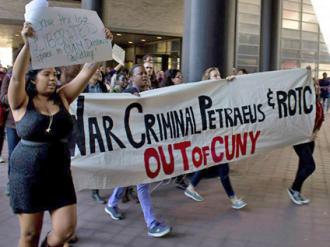
Students march against David Petraeus and the militarization of CUNY
WHO IS David Petraeus, what is he doing at CUNY and why are students fighting against him?
Sharmin: David Petraeus is the former CIA director, as well as the former military official involved in the wars in Iraq and Afghanistan and the illegal occupations.CAN YOU talk about his connection to the El Mozote massacre is in El Salvador?
Sharmin: Petraeus hired and worked with Col. James Steele who basically created the psychological terrorist agenda of massacring thousands of innocent people who were affiliated with anti-government or anti-system organizing. [The Atlacatl Batallion in El Salvador] would line the civilians up and shoot them in the head or knock them out.Petraeus was also responsible for the bombings of innocent civilians in Iraq and Afghanistan. He was one of the lead commanders who created a dialogue around the way that American massacres occurred during that time. He was one of the biggest voices that we heard in public justifying the crimes in Iraq and Afghanistan.
What you can do
Join the protests against David Petraeus, every Monday from 2:30 to 6:30 p.m. at 555 W. 57st St.
Join the rallies to defend the Morales-Shakur Center, every Monday and Thursday at 12:30 p.m. at City College, 137th and Covenant Avenue.
Sign the petitions to drop the charges against the CUNY 6 and to save the Morales-Shakur Center.
Join the rallies to defend the Morales-Shakur Center, every Monday and Thursday at 12:30 p.m. at City College, 137th and Covenant Avenue.
Sign the petitions to drop the charges against the CUNY 6 and to save the Morales-Shakur Center.
PETRAEUS WAS later head of the CIA, too. Aside from the whole scandal with his extramarital affair, what was his legacy in the CIA during the time he was there?
Oscar: I think that he furthered the agenda of imperialism through usage of drones--bombing places we weren't "officially at war with," such as Yemen and Pakistan, and thus furthering the agenda of U.S. imperialism.WHAT IS his position at CUNY?
Sharmin: Recently, Petraeus got hired as a professor at Macaulay Honors College at CUNY, which is an elite institution in itself. He is teaching a class called "Are We On the Threshold of the North American Decade?" and at first, he was offered about $200,000 to teach at CUNY. But after outrage by students and faculty who signed petitions and created an online response over the summer, his salary was reduced to one dollar.After the first few protests, there have been increased security measures, where private Escalades have picked him up, and cops and security officers were protecting him on CUNY dollars.
CUNY EDUCATES more students of color than any other university system in the country--is that right?
Sharmin: YesSO THAT includes people who might be from El Salvador or Iraq and Afghanistan. What does it mean for him to be teaching at a campus like CUNY?
Oscar: Before I touch on that point, I think we should also go back to Sharmin's point where he was offered a $200,000 teaching salary. I think it's a big slap in the face to any sort of professor or teacher who actually takes the time to become a career educator, when you have this person Petraeus, who's not a career educator, just a career murderer, and he gets by with all of this. I think this is a big slap in the face. I think that's part of the reason why the Professional Staff Congress (PSC), one of the CUNY unions, is also involved in protesting his lecture position at the College>/a>.Sharmin: His position also speaks to the acceptance that the CUNY administration has toward war culture and imperialism in general. This past year, Reserve Officer Training Corps has returned to CUNY campuses after being kicked out in 1971. Students--antiwar students and students who have a very personal relationship to the impact of imperialism within their homeland experiences--are really outraged by the fact that they are seeing army recruiters coming into our campuses, knowing that we are in a $25 billion debt bubble, with students are lacking opportunities for higher education and lacking opportunities for jobs.
With the military coming to recruit on campus it says a lot about what opportunities are being offered to working-class students who don't have access to better education or better jobs.
Petraeus' position also creates this culture of acceptance towards war culture. That people like Petraeus are allowed to teach here is not only blatantly disrespecting the families that he has violated, but it also represents that CUNY is accepting the militarization of culture.
If you look at the City College of New York advanced research center, we know that that $168 million research center is funded by gun manufacturers and companies like Lockheed Martin and Northrup Grumman. These companies are coming into CUNY under the illusion that they are providing jobs or access to engineering opportunities. But they are essentially perpetuating the military-industrial complex. It just becomes accepted and "normal" that people who are murderers and imperialist machines are coming to our campus.
CAN YOU talk about how the Ad Hoc Committee came together and started to build the campaign, and some of the highlights?
Oscar: It's a group of interested people from different campuses who've come together to rally and protest against Petraeus, the militarization of campus through the NYPD, the militarization through the ROTC programs, and what we've been facing in the current weeks--from the initial start of Petraeus' teaching to the takeover of our community center here at City College.Sharmin: When we got together in the summer originally, people were talking about the way we wanted to organize in moving forward. It was the "hit-the-ground-running" petition about Petraeus' original salary that really created a momentum that now we're going to protest. We've been open to the public. We've been based on a participatory model, and we've been very inclusive of different campuses.
There have been a lot of different people who have shown up. We have a lot of workers coming in from Hot & Crusty bakery, and a lot of workers coming in from day laboring. They have joined us in the struggle. It makes it a very intersectional conversation because a lot of antiwar organizations and staff, like the PSC, have come out in solidarity with us.
CAN YOU explain what happened to the Morales-Shakur Center, what the security presence has been, and how this connects to the campaign against Petraeus?
Oscar: On October 20 (which also happened to be in the middle of midterms), students heard from one of our comrades that the center was being locked down--so he sat down in front of the door to protest it, which eventually led to him getting arrested.I think that was the catalyst to what's been happening in recent days. On October 21, less than 24 hours later, we were able to pull together a good turnout at a protest to reclaim that space.
CAN YOU explain about the space?
Sharmin: Tthe Guillermo Morales-Assata Shakur Center is a center directed by students of color clubs, as well as marginalized peoples clubs like the Black Student Union or New York Students Rising, and organizations that are building leftist movements on campus. They use that space as a resource.It has been a space within City College that was won and continuously fought for over years of struggle--because the administration has continuously attempted to take it away. Stories of infiltration and NYPD spying on students within college campuses have also been recorded in spaces like this. We believe that this is happening as a direct form of repression against students who are mobilizing antiwar efforts on campus.
HOW HAS the closure of the center affected the campaign?
Oscar: I think the point Sharmin was making earlier is that now our main focus is not on Petraeus, it's on trying to regain our space--our space that has been taken away from us with no prior dialogue, with no respect for communities that work out of it.Sharmin: Having six students brutally assaulted and arrested by the NYPD shifted our movement energy real quick. Because of the violent repression, we had to organize a response to that, and then Petraeus ended up switching his class to a high-security building, a BMW building up on West 57th Street.
So there are these things the institution is doing in order to change our organizing tactics and methods, in order to derail a lot of the student mobilizing. Basically, shutting down the center was a great tactic to make students feel like they don't have a space to organize. I do believe that this type of momentum--where you had about a thousand students come out that day at City College when we had a mass protest--and those types of big crowd energies are what we can navigate to talk to huge groups of CUNY students.
How can we address a mass crowd of CUNY students without making them feel like their mission is not our mission, and also networking and building our base to understand that this Center represents our antiwar campaign, represents the anti-repression campaign for Muslim students, represents a lot of different struggles that we need to ally with and bring together, because state repression is coming from all ends?
How do we, as a collective body of Black, Brown, poor and working-class students reply holistically to really address the root of the problem, which is the security state, the NYPD and CUNY administration thinking that it's okay?
The CUNY administration has released statements in support of violent repression. They have been creating laws at City College to limit "expressive organizing," which is basically revoking First Amendment rights. These things are happening simultaneously, so we have to react very powerfully, using these really high-temperature moments to talk about the multitudes of repression.
YOU WERE holding actions outside of Petraeus' class. Can you talk about those a bit?
Sharmin: Every week, starting with his first class in September, we have been protesting. The first protest was unexpected, so we didn't have a lot of security present. But in the following weeks, we had at least 50-100 cops regularly at the classroom before we got there. The first week, we actually had the opportunity to run into Petraeus on his way home--he decided to walk over Central Park West, and students decided to tell him that he needs to get out of our campus.We've also protested at a gala where he was honored, the John Jay Education Justice Gala 2013We also protested outside Macaulay Honors where six students were brutally arrested and assaulted.
COULD YOU talk about those arrests?
Oscar: It was the second anniversary of Occupy Wall Street--September 17--and so New York City was perhaps hot that day, due to everything going on in the city. Petraeus used to lecture only once every week--on Mondays for three hours. So we made it a thing: We would be out there every Monday.The day of the second anniversary of Occupy Wall Street was also the day of the fundraiser. Things happened as usual. We were all there gathered, picketing. They specifically targeted six of our comrades, two females and four males, one of whom was on the ground, not resisting. There's a video showing the assault by police officers. I think it shows what kind of influence that Petraeus, in conjunction with the CUNY administration, has in repressing people voicing their opinions.
WHAT DO you envision as the next steps for the campaign?
Sharmin: With the chaos and the really great mobilization happening at City College, we definitely want to build this momentum to move on to a larger "demilitarize CUNY" agenda.We definitely are looking to take a lot of the "people power" that we're getting from this response [to the closure of the Morales Center] to bring it into the Ad Hoc committee and think about how these forces can ally, and how each campus can have their own group of bodies that are collectively addressing their campus' militarization.
We think this movement can never be won unless we have huge representation of CUNY faculty and student representation. We need more "allyship" from teachers who are sometimes hesitant to speak out about this because of their jobs--while also understanding that they're limited on time and limited on power. So we definitely need to figure out how we can push our power.
Oscar: I want to take that to the next level, with current issues about what's going on in the Center, and combine the momentum and get the militarization out of CUNY, and stop police repression of not only the LGBT community, but of the Muslim community, of students with black and brown faces.
I think that we also want to let Petraeus know that he is not welcome at our schools, that we do not approve of his message, and we do not approve of what he represents--which is a U.S. imperialist model.
HOW CAN people help the campaign and express their solidarity?
Sharmin: We're asking people to call the City College president and CUNY Board of Trustees to highlight the importance of talking about this right now. We are accepting statements of solidarity. We have teach-ins and speak-outs regularly--if people have a couple of hours to stop by and talk about how they feel, we would like that.We are definitely looking to mobilize larger social action movements throughout each campus, so that even if it's by contributing flyers or contributing the ability to create a great Facebook event or great image, we are looking for all these skills.
I think the Ad Hoc Committee has been running based on all these little things that people are doing, but bringing together a bigger, stronger movement because we understand that people have limited time or limited capacity. But creating a flyer is a really important task that people need to take hand in.
Oscar: I think that we need to expose and bring the spotlight to our issue. With the takeover of the center, we want to involve more of the people who are affected by the center not being there--making it an inclusive circle of CUNY students who are involved. We also need to bring unions in, because we need more strength in numbers.
For me, as a member, not necessarily of CUNY, but of the community that's affected, this deeply concerns me. That's why I'm here. I've been here every day since, and I won't stop.
http://socialistworker.org/2013/11/06/stop-the-militarization-of-cuny
Stop-and-frisk ruling on hold
explains how a federal appeals court is blocking a judge's historic decision to declare the NYPD's hated "stop-and-frisk" policy unconstitutional.

Judge Shira Scheindlin (Joel Spector)
ON AUGUST 12, District Court Justice Shira Scheindlin issued a historic ruling that the New York Police Department's racial profiling policy known as "stop-and-frisk" violated the constitutional rights of its victims. Scheindlin determined that stop-and-frisk relied on a "policy of indirect racial profiling," and she mandated a set of reforms, including an independent monitor for the NYPD. This long-overdue victory in Floyd v. the City of New York came after a nine-week trial, 23,000 pages of evidence, more than 8,000 pages of testimony and 14 years of related litigation.
But with a single hearing and a two-page ruling, the 2nd U.S. Circuit Court of Appeals blocked all this on October 31.
A three-judge panel from the higher court issued a biting rebuke of Scheindlin, claiming she violated the "appearance of impartiality" in judging the case, and removing her from all related stop-and-frisk cases. The decision effectively put on hold all the mandated reforms from Schendlin's decision and threw her findings into a legal limbo.
"Basically, this court is saying to the citizens of New York, who have followed this case and who were very uplifted by the fact that a federal judge stood up to protect the rights of all citizens of the city of New York...the panel of the 2nd Circuit [said]: 'Drop dead, New York,'" said Jonathan Moore of the Center for Constitutional Rights (CCR) and the lead attorney in the Floyd case. "It's embarrassing, it's unprecedented, and it's a travesty of justice that this panel did this."
So what was Scheindlin's crime that required the circuit court to stay her decision? Supposed "improper application of the Court's 'related case rule'"--which allows for related litigation to be directed to the same judge--when she advised lawyers in the original stop-and-frisk case to file a new lawsuit and to direct it to her as related. In addition, the circuit court ruling references media interviews and public statements Scheindlin made in response to earlier accusations of impartiality.
What you can do
Sign the Center for Constitutional Rights petition demanding that the next mayor of New York City drop the appeal of Judge Scheindlin's historic ruling against stop-and-frisk.
Even more ironically, the interviews referenced by the 2nd Circuit are ones in which Scheindlin notes what sees as other judge's bias in favor of government attorneys--and emphasizes her impartiality.
"I do think that I treat the government as only one more litigant," Scheindlin said in one of the stories cited, a May 29 AP article. "I don't think they're entitled to deference...They have to prove their case like anybody else. I don't give them special respect. Maybe some judges do because they came from that office, they know people there, whatever. I try not to do that." In a New Yorker article, Scheidlin is quoted as saying, "I don't think I'm the favorite of the U.S. Attorney's office for the Southern District. Because I'm independent...I'm not afraid to rule against the government."
In other words, Scheindlin is accused of being biased on the basis of media interviews where she primarily discusses her lack of bias in favor of the government. Perhaps the 2nd Circuit didn't like Scheindlin's suggestion that other judges do show deference to federal prosecutors.
In appealing Scheindlin's decision, lawyers for the city didn't raise any issues about Scheidlin's impartiality, nor did they ever object to the Floyd lawsuit being assigned to her. As Emily Bazelon points out at Slate.com, this means the issue was never discussed in court documents or at a hearing, and so Scheindlin was never given a chance to respond.
In a highly unusual and seemingly vindictive move, the Circuit Court judges went out of their way, looking beyond the record in front of them, to disqualify Scheindlin.
- - - - - - - - - - - - - - - -
SCHEINDLIN HAS long been a target of New York City Mayor Michael Bloomberg and Police Commissioner Ray Kelly, who have sought to paint her as biased against the city and especially law enforcement. According to Juan Gonzalez, speaking on Democracy Now following the appeals court decision, the mayor's office "created a dossier that it then shopped to various media around the city, [trying] to get them to write articles to reflect the Bloomberg administration's viewpoint that the judge was biased."
But as activists in the police accountability movement know, the real bias is in favor of law enforcement, and it comes from the city government and the state and federal courts. As Djibril Toure, an activist with the Malcolm X Grassroots Movement and defendant in the original Daniels v. the City of New York case from the early 2000s, said in an interview:
There's a tremendous amount of hypocrisy in this ruling...We've seen so many cases of people being killed by police officers under questionable circumstances and so few of those officers have even been punished in any way...The system has been so biased for so long in favor of police officers that [Scheindlin's] honest assessment seems to them to be biased. She's just saying what everyone else in the city sees, which is that innocent people of color are being stopped in large numbers for no reason.The Bloomberg administration no doubt been desperate to stem the growing movement against stop-and-frisk in New York City. As a result of the Daniels case, the city was forced to hand over data revealing that between 2004 and 2012, 4.4 million people, overwhelmingly Black and Latino, were stopped by the NYPD. Some 88 percent of reported stops resulted in no arrest or ticket--meaning that stopping and searching millions of innocent people of color is just normal operating procedure for the NYPD.
Protests against stop-and-frisk have mounted in the last two years, including a mass silent vigil and march down Fifth Avenue in 2012 and hundreds of smaller protests and direct actions at police precincts and elsewhere. Scheindlin's ruling in August was quickly followed by the City Council passing the Community Safety Act, which authorized the creation of an inspector general's office to be a watchdog over the NYPD, and made it easier for New Yorkers to sue if they are racially profiled by police.
Incoming Mayor Bill de Blasio, who will replace Bloomberg after defeating Republican Joe Llota in a landslide on November 5, first surged to the front of the pack this summer in part because of his prominent opposition to stop-and-frisk. The mayoral primary election campaign leading up to the vote in September produced the rare spectacle of leading Democrats tripping over each other to prove their opposition to a major police tactic.
- - - - - - - - - - - - - - - -
DESPITE THE triumphalism from supporters of stop-and-frisk, it's important to remember that Scheindlin's landmark ruling hasn't been overturned. The 2nd Circuit hasn't yet ruled on the city's appeal of the Scheindlin decision, which won't be heard until the spring.
But after the three-judge panel blocked the reforms required of the NYPD, the outlook isn't hopeful at this level of the "justice" system. This is the same 2nd Circuit--with the same head Justice John Walker, first cousin of former President George H.W. Bush--which ruled in Brown v. Oneonta that that it wasn't unconstitutional for police, while searching for a Black suspect, to stop every single Black male they could find in the town of Oneonta, going so far as to obtain a list of all African American male students from a local college.
Luckily, the fate of stop-and-frisk doesn't depend solely on the justices of 2nd Circuit. For his part, Bill de Blasio, in his previous office as the city's Public Advocate, filed an amicus brief against the City's request for a stay of Scheindlin's ruling and has pledged to drop the city's appeal once in office. Moreover, as the new mayor, de Blasio will have direct control over NYPD policy and could directly end the use of stop-and-frisk, regardless of what the courts say.
But it remains to be seen exactly how de Blasio will manage this situation once in office. Since winning the primary, de Blasio's promises to "end" stop-and-frisk have morphed into talk about "reforming" the policy. Even more troubling, de Blasio's short list for the next police commissioner includes William Bratton--the same Bill Bratton who initiated Rudolph Giuliani's tough-on-crime regime in the 1990s with an aggressive "broken windows" doctrine of policing that likewise relied on harassing large numbers of people of color over minor violations.
Anti-police violence and police accountability activists across the city understand the need to keep the pressure up against the NYPD's intimidation tactics. Communities United for Police Reform, a coalition that played a major role in pushing for the passage of the Community Safety Act, has called a protest the day after Election Day to pressure de Blasio to make good on his promise to drop the city's appeal of Scheindlin's decision.
As Djibril Toure put it:
The court delay is not surprising because we understand there's a political nature to the 2nd Circuit. What's more important is that the discussion on stop-and-frisk and over aggressive policing has started and amplified over the last two years. The tide has turned in terms of public perception of these tactics. I don't think we're going to go back to a situation where 700,000 people are being stopped on a yearly basis.Police Commissioner Ray Kelly felt the turning tide outside the city last week when a planned lecture at Brown University was disrupted by student protest and canceled. The department has been backpedaling on its open defense of racial profiling--stop-and-frisks have declined from a high of 684,724 in 2011 to 533,042 in 2012 to even lower in 2013. However, Cop Watch activists patrolling neighborhoods with the most stop-and-frisks report a continued heavy police presence, even if they are fewer stops.
The fight against police brutality and aggressive police tactics will be long and hard. But momentum is still on the side of activists fighting against the NYPD's abuses and violence.
http://socialistworker.org/2013/11/06/stop-and-frisk-ruling-on-hold
Corporate school deform vs. education justice
In the first of a two-part article, Berkeley, Calif., teacher discusses strategies for confronting high-stakes standardized testing and attacks on teachers.
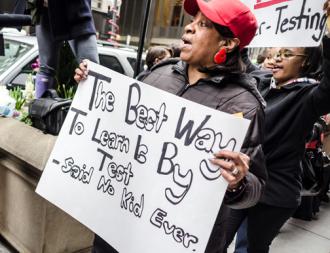
Teachers, parents and students march against the school deform agenda in Chicago (Sarah-ji)
FROM RESISTANCE to high-stakes testing to a more assertive voice from teachers' unions, big-money corporate education "reformers" are encountering significant new resistance. Now is the time for teachers to step up our defense of public education, both by highlighting the destructive impact of the so-called reforms and by building on the emerging alliance between our unions and the communities we serve.
This article attempts to summarize some of these important shifts and highlight places where our side can organize and push back, starting right now. The prospects for teachers unions in the struggle ahead will be the subject of the second part of this article.
It's difficult to exaggerate the damage done by the education reformers. I've been a public school teacher in California for 12 years--a time that coincides with implementation of the federal government's misnamed No Child Left Behind (NCLB) law.
NCLB unleashed the current wave of corporate school reform: the use of standardized testing to punish failing schools and evaluate every teacher's effectiveness; the increase in privately run charter schools claiming to be an "option" for students in "failing" public schools; and a massive growth in for-profit textbook and testing enterprises that feast on funds from school district trying desperately to make yearly progress targets--goals that move further and further out of reach each year.
At the same time, I've seen a whole generation of new teachers who burned out early from the prospect of teaching under the gun of standardization and the lack of job security from perpetual cycles of budgets cuts in public education. Meanwhile, teacher farms like Teach for America place more and more young people in the front lines of education without adequate preparation, only for them to leave the profession for better jobs with less collateral damage.
But recent cracks in the corporate education reform monolith have given rise to new hope. New studies validate what teachers have known all along--top-down, punishment-based reforms don't work. They don't work for creating a profession that people want to dedicate their lives to, and they don't work for the students who are most underserved by public education.
- - - - - - - - - - - - - - - -
What is the corporate education reform agenda?
One key task for the movement to defend public education is to clearly define corporate education reform since the inception of NCLB.
Certainly an argument could be made that corporate education reforms has always been a part of the agenda for the ruling class in this country, ever since public education became a demand of the working class. But in the past decade or so, corporate reform has become explicitly linked with larger neoliberal policies, in the form of privatization and outsourcing of education.
Education reform has been characterized further by the application of market-based practices and measurements on the institutions of public education, and the evaluation of teachers and students using measures like norm-referenced tests. These standardized tests have come to be labeled "high stakes"--and represent one of the most universal features of corporate education reform.
As a result, schools are now evaluated based on student performance and high-stakes tests--and schools must make decisions based on improving test scores above all else in order to avoid punishments. NCLB mandates that if schools fail to show better results, local or state school authorities must take control of its management and operations. This takes away both school site and teacher decision-making power over how--and how much --instruction happens in certain subjects.
Schools that don't meet arbitrary yearly progress on these standardized tests are labeled "program improvement schools" and must make changes to their programs and instructional models to make student performance on tests a priority. This usually means cutting arts, physical education and enrichment programs in order to make more time for student instruction in materials that will be on the standardized tests. Students spend hours reviewing reading, writing and math skills, and have little time for any other subject areas.
Make no mistake: this does not mean students will spend more time deepening their essential literacy and math skills. Rather, they will spend time learning the very distinct skills it will take to do well on these very specific multiple-choice tests. The tests are created by companies, not teachers, creating an all-or-nothing situation where no other standards are used to measure the growth of students or schools.
Corporate education reformers try to justify this by claiming that teachers don't believe in assessment. Therefore, they say, standardized tests are the only way to overcome this resistance and figure out how our kids are really doing--and what teachers are not doing for them.
The reality is that most teachers spend hours of time figuring out what our students know and don't know so that we can best instruct them in real skills and concepts that we know are critical for them to be successful in life-long learning. As a result of the prioritization of standardized tests over teacher-created assessments, schools spend an inappropriate amount of time gearing all student instruction and practice towards getting students to perform on these tests.
An example: Instead of giving students a multiple-step word problem connected to a real-life situation that they can solve collaboratively, a teacher is forced to assign students endless worksheets of multiple choice, low-level math questions that align to the standardized tests.
Schools that don't adapt and gear instruction towards test performance and continue to show "inadequate" progress are labeled as "failing." Rather than receive support, they are instead closed or taken over by policymakers who have never spent a day in front of a classroom full of students--people who are nevertheless deemed "experts" in education.
One of the most despicable aspects of the corporate education movement is that it frames this process of closing schools and punishing teachers and students as a way to support the achievement of low-performing students--in particular, students of color. Public education in the United States is fraught with deep inequalities and racism--but these are not the problems that corporate education reformers want to address. In fact, they exacerbate them by creating a permanent underclass of "failing" schools where students and teachers who can leave, do so. This further deepens inequality within and across school districts.
Reformers pose as if they care about our kids, especially the poor and students of color who have been marginalized by public education and other institutions. Yet reformers do nothing that supports our students really learning.
Sometimes, corporate reformers sweeten the deal of closing neighborhood schools by giving some parents the option of taking their kids to charter schools nearby. This is the most disgusting part of the process: Charter schools select only the students they deem as potential successes. The rest are left to flounder in neighborhood public schools that continue to be treated as pariahs, and get fewer and fewer chances to improve, due to both a lack of funds and an extreme narrowing of the curriculum.
At the same time, charters seemingly flourish because they select reject students who have too many "problems"--often enough, they have no requirements to meet high-stakes testing targets. Education academic Linda Darling-Hammond has studied what she calls "redlining," documenting the destructive impact of charter schools' selective migration policies.
The corporate reform machine has also taken away local control over schools to prevent parents and the community from challenging school closures and the "punish failing schools" agenda. Governance instead is under the oversight of policy wonks who have no connection with local schools, nor stakes in their success. In some urban districts mayors--who, last time I checked, are not required to have any expertise in education--have used test results as justification for taking control of schools and instituting top-down "reforms" and school closures that have devastated communities and families.
By putting schools in the hands of people driven only by the bottom line and not any desire to educate kids to be successful in the world, the education reformers are creating generations of students who are unable to think critically, unprepared to get decent jobs or unable to fully participate in higher education. This further exacerbates the gap between students in wealthy, high-performing districts and those who lack access to a well-rounded, enriching educational experience.
Corporate education reform has not closed the "achievement gap," but rather has exacerbated it. It hasn't brought up impoverished schools, but has instead starved them even more. Reform hasn't brought better schools to communities, but forcibly taken control of schools from the very communities and families they serve. It hasn't made schools places of learning and student engagement, but an arena for standardized testing, with a curriculum designed to ensure that students learn only the most basic skills needed for unfulfilling, low wage jobs.
- - - - - - - - - - - - - - - -
What has corporate education reform done to the teaching profession?
Corporate education reform has devalued the teaching profession and trumpeted the false narrative that teachers are to blame for the failures of public schools.
The reformers have detached the issue of how to improve teacher quality from real conditions in the schools, and real programs that have been shown to produce high-quality teachers. They have defined teacher effectiveness using the narrowest of terms and invested millions of dollars in data systems and tests to replace the professional, collaborative learning environments that do improve teachers' craft, fostering instead an atmosphere of competition among teachers.
The corporate reformers' narrative goes like this: The main problem with failing schools in ineffective teaching, and the only way to change that is to motivate teachers through corporate-style incentives based on performance (so-called "merit pay") and punishments, like being fired, for failing to meet arbitrary standards.
The fatal flaw in this logic--as anybody who has ever spent time with a public school teacher knows--is that teachers are not really in it for the money and the glory of meeting standards. They most likely come to work, day in and day out, to make learning happen, despite overcrowded classrooms and inadequate materials. They teach under the constant real-world pressures of poverty and racism, which take a toll on each of the young human beings in front of them.
Teachers often come to work not because of the paycheck, but because of their deep desire to educate children. This isn't to say that money is unimportant. But there are other jobs out there that pay well and don't require years of education and ongoing professional development, not to mention a high tolerance for ongoing chaos and crisis.
For teachers on some days, you are also a social worker, nurse and family counselor, at the same time that you're trying to help all your students learn inordinate amount of material outlined by the state standards (or the new Common Core standards.)
The idea that the way to improve education is to incentivize the teaching profession just doesn't fit with the actual profession of teaching. Many people become a teacher exactly so that they can escape the corporate rat race--and feel like they're making a difference in the lives of young people.
Corporate education reform directly attacks teachers' ability to do their jobs well. It has eroded tenure and seniority rights, led to the firing of massive numbers of teachers, and done nothing to show that any of these policies have improved the quality of the teaching force.
The reformers have made it harder to retain innovative and creative teachers, especially new teachers, who are lured to education by the promise of doing something meaningful, only to find endless amounts of work outside of paid time, insurmountable challenges that often get in the way of delivering instruction, and punishment instead of support when they need help.
In California, budget cuts have meant that more than 30,000 teachers have been laid off since 2008, many of them new to the job. These job cuts, combined with the changing pressures on the teaching profession, have meant some of the brightest young teachers in our schools have permanently left the profession. Fast-track teacher training programs like Teach for America claim to be filling our schools with more young, excited teachers, when in fact they're setting people up to fail because of a lack of training and support.
One of the most insidious problems with corporate education reform is the effort to pit teachers against students. The reformers refuse to acknowledge the real fact that our working conditions as teachers are the learning conditions of our students. In most cases, what we demand with regard to decent classrooms, materials and reasonable class sizes are aligned with what is in the best interests of our students.
- - - - - - - - - - - - - - - -
Has the corporate education agenda been successful?
Some good news: Recently, corporate education reformers have begun to get bad press, and some cracks have appeared in their confidence. Simultaneously, local districts and state governments like California are using the transition to the new quasi-national Common Core standards to push back on some aspects of high-stakes testing and federal programs like Race to the Top, which require states to gut union rights and follow accountability measures to receive funding.
The Common Core, which on paper appears to offer better learning targets for our students, is in fact rife with the same corporate education garbage that has been part of the standards movement from the inception of NCLB. Education historian and reform critic Diane Ravitch has written some insightful pieces on the Common Core that are worth a read for more background.
In New York state, one of the earliest adopters of the Common Core, the rollout of the new standards and new assessments has been a disaster. Angry parents have begun to reject the new Common Core-aligned assessments in large numbers, sparking a small but significant movement of parents to do the same from Louisiana to Oregon.
The critical boycott against the Measures of Academic Progress (MAP) test by several Seattle schools sparked a similar national dialogue about using assessments that are not aligned to classroom instruction to evaluate students and teachers. In the last year, Georgia, Oklahoma, Pennsylvania, North Dakota and Alabama, which had been adopters of Common Core standards, have dropped out completely or scaled back their implementation of the new standards and the tests that come with them. Florida rejected the new Common Core benchmarks this month.
In California, the state legislature passed a bill this month doing away with the old standardized tests for the current school year. In a move that looked like a game of political chicken, State Superintendent of Schools Tom Torlakson told Education Secretary Arne Duncan that California schools would not be subject to No Child Left Behind accountability measures this year as we transition to new learning standards. Duncan threatened to pull all federal funding for California schools, but Torlakson held the line and the bill has become law.
As a result, there's a brief statewide moratorium on high-stakes testing this year, and possibly beyond. This presents a real opportunity for our side to push back against the NCLB testing agenda. While this window is small, schools have a chance to breathe for a moment and begin a real dialogue about why high-stakes testing needs be dismantled permanently.
So besides a lot of stress what have we gotten for twelve years of NCLB accountability?
Rather than solving issues of student achievement and improving teacher effectiveness corporate reforms, like high-stakes testing, have led instead to high-profile cheating scandals. Further, there's no conclusive evidence that students in privately run charter schools do any better than their public school counterparts.
Around the country, studies have shown the only thing that's consistently correlated to NCLB policies is widespread cheating, from school administrators to teachers and even to parents, all of whom are desperate to keep schools from being punished for "failing." Even Michelle Rhee, a high-profile education reformer when she ran public schools in Washington, D.C., has been implicated in such scandals.
The very foundation of the neoliberal education platform--that we must use standardized testing to measure effectiveness of students and teachers--has proven at its heart to be utterly flawed.
Standardized testing isn't the only area where corporate education reformers are taking a hit. A recent national Stanford University study also shows rather conclusively that privatization of schools through charters and vouchers isn't helping students learn better than their peers in public schools.
The data proves that rather than fix education, corporate reformers have created a high-pressure environment where the larger questions of what kind of education students really deserve has been completely lost. They've left in their wake decimated teachers unions and demoralized students and parents. Forbes magazine--not a bastion of liberal opinion, to be sure--called out charter schools and their direct link to funding high-profile political campaigns, while at the same time pointing out that there is absolutely no conclusive evidence they help students learn better.
Given this poor record, when teachers unions confront the corporate reformers, they can win the public support of parents and the community. That's a key lesson of the Chicago Teachers Union strike of 2012, which held the line against Mayor Rahm Emanuel's union-busting demands. The union followed that fight with a campaign against school closures that, although unsuccessful, exposed the unpopularity of the mayor's schools agenda.
The declining popularity of the corporate reformers' program has compelled several mayors to repackage their education program in less confrontational terms. Bill DeBlasio, the mayor-elect of New York City, defeated his rivals in the Democratic primary earlier this year in part by rejecting Mayor Michael Bloomberg's education program.
Of course, these shifts don't mean that politicians suddenly believe now in keeping public education public or in getting rid of the test-and-punishment policies for school funding. Rather, there is a small opening in what was once an impenetrable wall of corporate education policies. Increasingly, the public realizes that the changes we need to make to our education won't come from business people and corporate interests, but must come from somewhere else.
- - - - - - - - - - - - - - - -
What do these shifts mean for teachers who are trying to reclaim our vision of public education from the corporate reformers?
These developments will mean nothing unless we use them to get organized and fight back.
No Child Left Behind is not on its deathbed. New standardized tests linked to the Common Core standards--even more challenging and comprehensive--are coming down the pipe. Charter schools continue to steal resources and students from school districts. Politicians continue to make policies that are detrimental to students and seek to break teachers unions across the country.
If we don't use this information to begin to form our own platforms for what we think public schools should be, we will miss a tremendous opportunity. Inspired by the struggles of the CTU and teachers in Seattle, teachers unions are starting reach out to our communities and to find common ground to struggle for better schools for all our students, the schools they truly deserve.
Part Two of this article will focus more specifically on what teachers unions are doing--and what we need to do to reclaim our vision for public education.
http://socialistworker.org/2013/11/06/corporate-reform-vs-education-justice
Message to the National Lawyers Guild 2013 Convention
October 28, 2013
Brothers and Sisters of the National Lawyers Guild;
I wanted to send you this most important Health Bulletin–Not Personal (pause) but on the steady evisceration of the Right to Counsel, the bulwark of all we do.
Within the last weeks, a suspect was forcibly detained for crimes against the US. He was taken from Libya to an offshore (ship?) where he was being interrogated, read tortured.
When the Public Defenders of the Southern District of New York, where his case is ostensibly pending, attempted to have counsel appointed for him, they were turned down in no uncertain terms by Judges using the now all too common weasel words. But this is not a new phenomenon–it is apparent over and over again and the question remains–what are WE, who claim to be the last protection against an overreaching state going to do about it?
Within the last weeks, a suspect was forcibly detained for crimes against the US. He was taken from Libya to an offshore (ship?) where he was being interrogated, read tortured.
When the Public Defenders of the Southern District of New York, where his case is ostensibly pending, attempted to have counsel appointed for him, they were turned down in no uncertain terms by Judges using the now all too common weasel words. But this is not a new phenomenon–it is apparent over and over again and the question remains–what are WE, who claim to be the last protection against an overreaching state going to do about it?
How important is this ?
I need to tell a couple of anecdotes about lawyering–my dear deceased friend Bill Kunstler in the tumultuous years in which the FBI-JTTF was rounding up the remnants of the Underground, Sekou Odinga, a member of the Black Panthers and then the Black Liberation Army, related to me that he had been detained in a Queens NYC precinct for many hours, was being water boarded by the police in one of the toilets, and was really feeling it badly when all at once he heard the booming voice of the Great Kunstler echoing through the hallways demanding to see his client and he knew that he had been saved.
The other story was one that I told at an earlier convention and a young lawyer from San Diego wrote to tell me that it had turned her life around. After my arrest, Ralph and I were stuck in Manhattan traffic, when a bicycle messenger pulled up and tapped on my window. When I opened it he said in an excited and joyous voice “You THE Lawyer !! You the LAWYER !!! Indeed I was and Indeed it was and is my greatest ambition and accomplishment to be THE lawyer.
I need to tell a couple of anecdotes about lawyering–my dear deceased friend Bill Kunstler in the tumultuous years in which the FBI-JTTF was rounding up the remnants of the Underground, Sekou Odinga, a member of the Black Panthers and then the Black Liberation Army, related to me that he had been detained in a Queens NYC precinct for many hours, was being water boarded by the police in one of the toilets, and was really feeling it badly when all at once he heard the booming voice of the Great Kunstler echoing through the hallways demanding to see his client and he knew that he had been saved.
The other story was one that I told at an earlier convention and a young lawyer from San Diego wrote to tell me that it had turned her life around. After my arrest, Ralph and I were stuck in Manhattan traffic, when a bicycle messenger pulled up and tapped on my window. When I opened it he said in an excited and joyous voice “You THE Lawyer !! You the LAWYER !!! Indeed I was and Indeed it was and is my greatest ambition and accomplishment to be THE lawyer.
Back in the day and I mean way back, when this adversary system had its origins, the accused had the right to select a champion to fight for their rights and I mean fight–jousting, swordplay, mace and chain — ok perhaps a little hyperbole, BUT the message is clear–we were hired for our brawn as well as brains, our courage as well as legal acumen.
We need to get courage and creativity in combat, back into the equation. It’s not about schmoozing the prosecution or the Judge. How many courtrooms have I walked into where there was not one friendly face–there was just me and the client ? Even the stenographers were hostile ! And that’s ok because I was there for only one reason, the one I took an oath to zealously pursue, the defense of my client. Was it fearsome personally? Of course. But to do otherwise was more so.
We need to get courage and creativity in combat, back into the equation. It’s not about schmoozing the prosecution or the Judge. How many courtrooms have I walked into where there was not one friendly face–there was just me and the client ? Even the stenographers were hostile ! And that’s ok because I was there for only one reason, the one I took an oath to zealously pursue, the defense of my client. Was it fearsome personally? Of course. But to do otherwise was more so.
I urge everyone to return to the days of robust lawyering. Be Bill Kunstler in the precinct. Be “THE LAWYER”. Be the champion who defends fearlessly. When I say that the right to counsel is being eviscerated I mean that the forces of the empire are very busy removing the nerves, the hearts and guts of the Fifth Amendment and leaving it a shell of what it was and can be. We are the opposition that need to gather our shields and swords in its defense and be selfless and brave. Let us press forward–Instead of the derision we often face, let us all strive to be “the Lawyer” respected and honored.
Lynne Stewart
--
Freedom Archives
Freedom Archives
--
SIGN THE JERICHO COINTELPRO PETITION!
Free All Political Prisoners!
www.jerichony.org
Bonnie Kerness speaking on solitary confinement:
Watch this compelling video of Bonnie Kerness speaking on solitary confinement:
https://www.youtube.com/watch?v=5Y4NMj3Kdvo
--
SIGN THE JERICHO COINTELPRO PETITION!
Free All Political Prisoners!
www.jerichony.org
https://www.youtube.com/watch?v=5Y4NMj3Kdvo
--
SIGN THE JERICHO COINTELPRO PETITION!
Free All Political Prisoners!
www.jerichony.org
Medical Ethics Have Been Violated at Detention Sites, a New Report Says
By DENISE GRADY and BENEDICT CAREY
Published: November 4, 2013
A group of experts in medicine, law and ethics has issued a blistering report that accuses the United States government of directing doctors, nurses and psychologists, among others, to ignore their professional codes of ethics and participate in the abuse of detainees in Afghanistan, Iraq and Guantánamo Bay, Cuba.
The report was published Monday by the Institute on Medicine as a Profession, an ethics group based at Columbia University’s College of Physicians and Surgeons, and the Open Society Foundations, a pro-democracy network founded by the billionaire George Soros. The authors were part of a 19-member task force that based its findings on a two-year review of public information. The sources included documents released by the government, news reports, and books and articles from professional journals.
Among the abuses cited in the report are doctors’ force-feeding of hunger strikers by pushing feeding tubes into their noses and down their throats. The task force also suggested that medical personnel ignored their duty to report evidence of beatings or torture of detainees, and that the Defense Department “improperly designated licensed health professionals to use their professional skills to interrogate detainees as military combatants, a status incompatible with licensing.”
The panel, the Task Force on Preserving Medical Professionalism in National Security Detention Centers, is not the first to protest what it said were violations of medical ethics at detention sites. Other groups that have described abuses include Physicians for Human Rights and the International Committee of the Red Cross. The Central Intelligence Agency and the Defense Department dismissed the new report as unsubstantiated and incorrect. Lt. Col. Todd Breasseale, a spokesman for the Defense Department, said in an email: “Task Force Guantánamo routinely provides comprehensive and humane medical care to the detainees held at Guantánamo. They are consummate professionals working under incredibly stressful conditions.”
Colonel Breasseale defended the force-feeding of hunger strikers via nasal tubes, which he referred to as “enteral feeding,” as legal and necessary to prevent them from committing suicide by starvation.
As of Monday, there were “14 detainees refusing to eat on a regular basis, and each is approved for enteral feeding,” he said. “While detainees may be on the enteral feed list, they do not always require the tube feeding — frequently they will drink the supplement or eat a meal out of sight of their peers.” Dean Boyd, a C.I.A. spokesman, said in an email: “It’s important to underscore that the C.I.A. does not have any detainees in its custody and President Obama terminated the Rendition, Detention and Interrogation Program by executive order in 2009. The task force report contains serious inaccuracies and erroneous conclusions. The agency is proud of its medical staff, who uphold the highest standards of their profession in the work they perform.”
According to the new report, the C.I.A.’s Office of Medical Services drew up guidelines that called for medical personnel to be present during interrogations to ensure that no “serious or permanent harm” resulted. For instance, exposure to cold was to be stopped just before hypothermia was likely to set in, and loud noise was to be halted just before permanent hearing damage would occur.
The report claims that C.I.A. medical personnel were present during waterboarding, and that “the guidelines advised keeping resuscitation equipment and supplies for an emergency tracheotomy on hand.”
The military, it says, has adopted some of the interrogation techniques that the C.I.A. developed, including the use of doctors and psychologists to help with interrogations. The report is particularly critical of the American Psychological Association for allowing psychologists to participate in interrogations.
The military has long employed psychologists in its “behavioral science consultation teams,” known as Biscuits, to assist with interrogations. Little is known about these teams, except that they study detainees, suggest lines of questioning and help decide when tactics are too harsh and when it is time to push harder.
“What we’d like to see from the association is a prohibition saying that psychologists cannot participate in any individual interrogation of a detainee,” said Steven J. Reisner, the only psychologist on the task force that produced the report.
Dr. Reisner, who practices in New York, is president of Psychologists for Social Responsibility, a nonprofit group that advocates the ethical application of behavioral science. He is running for president of the American Psychological Association.
“We’d also like to see the association acknowledge what is already widely known about psychologists’ participation in interrogations, and use those as examples of what psychologists cannot and should not do,” he said.
The association’s members have been debating its ethics guidelines regarding interrogation for years. In 2008, in documents alleging abuse, lawyers for a detainee at Guantánamo Bay singled out a psychologist as a critical player. At the time, the guidelines stated that it was “consistent with the A.P.A. ethics code for psychologists to serve in consultative roles to interrogation and information-gathering processes for national-security-related purposes” — as long as the interrogation did not involve any of 19 coercive procedures, including the use of hoods, waterboarding and physical assault.
Later that year, the membership voted to prohibit any consultation in interrogations at Guantánamo or other so-called black sites run by the C.I.A.
But the association has not gone as far as the new report urges: It has not prohibited psychologists from assisting in all interrogations. Psychologists are divided over the wisdom of such a blanket prohibition, with some arguing that it would only reduce the level of accountability during interrogations.
Whether a blanket prohibition would alter military protocols is hard to say. Like most professional groups, the psychological association has little direct authority over its members.
In a statement released on Monday, the association said it supported many of the recommendations in the report, including ethics training for psychologists working with the military and intelligence services. But, it added, the association has already issued repeated statements that “have forbidden psychologists from perpetrating or supporting torture; obligated psychologists to report torture and abuse; and prohibited specific enhanced interrogation techniques, such as waterboarding.”
--
Freedom Archives
Freedom Archives
--
SIGN THE JERICHO COINTELPRO PETITION!
Free All Political Prisoners!
www.jerichony.org


